
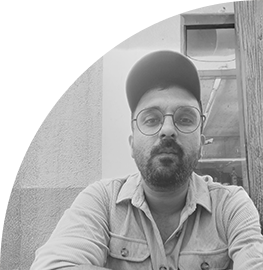
I ride past these fields daily, but today their green has faded to mustard brown. Between villages and faulty infrastructure, I recall my shopkeeper’s uncle, who killed himself after untimely October downpours. The crop failed; the Rabi seeds drowned before nurtured. To us settlers, the landscape lost its charm. Climate change: I tag the phenomenon and deliberate over the invoice I should have raised; the fake-grain laminate the clients picked, offending my modernist training; and the coffee shop where I’ll fight fatigue later. The farmer’s loss lingers between my affinity for Nano Banana and the next gig that might keep me from sliding further down my economic grouping.
Things feel different with age; I remember caring deeper. The world once seemed kinder. I fantasise about economic frameworks that believe in a greater good, knowing none are all-inclusive. It seems we sink in Future Shock: too much, too fast, too soon: unable to weigh inheritance against the immediate. Marketplace eats memory; feed overtakes field.
I feel like I am many people, with scattered, inconsistent personalities.
Midday doomer
Reefs on the Nicobar coast shifted between the 2020 and 2021 maps, as Scroll reported. The new version marks them at depths where corals cannot grow. They have, by divine will, shifted their ground and the “ecologically sensitive” tag that stood in the way of an international transhipment terminal. Scrolling further, between cozycore interiors and GRWM carousels, I come across Goa’s 17-storey Unity Mall proposal on the wetlands that feed Toyyar Lake, meant to promote local crafts and culture, reminding me of all the Marginlands—coastlines and riverbanks that concrete embankments have destroyed, along with agrarian and craft communities, symbiotic knowledge systems, and their intimacy with land.
When glitched recordings of peacock cries went viral, as JCBs followed them to extinction in Hyderabad, I woke in sweats on some nights; on others, I escaped survivor’s guilt, sweating on the deep-tech floor of a neighbourhood speakeasy.
Bombay boy
Nived is a ritual that lived on in my grandmother’s kitchen until she did. With no context, it made little sense to me. With every seasonal shift, old grain, puffed and mixed with jaggery, was offered to the mother goddess before equal portions were distributed to the extended family, long after migrating to the big city. I learnt later that the practice continues in arid regions, from where I inherit my genetics and my grandparents their childhood lessons in ritual. Before the monsoon does its India darshan, children collect broken grain from neighbours, secularly, as village elders prepare and enjoy this sweet concoction, before everyone labours to repair and build bunds for check dams that will keep the village hydrated until the winds visit again. Sung through cooking, celebration, and toil, folk ballads of drought and defiance hold the wisdom to endure famine.
As the Lodha and Lokhandwala around me get taller, the stream of water in our ‘80s rusted conduits thins out, and I am forced to think about this displaced inheritance in time and land, and with it unshared labour and lost resourcefulness: that we outsource until we too will be displaced by the laws of the big city.
Questionable architect
One’s modernist obsessions with form were inherited through architecture school. None of these studios trained one to build a practice situated between the pyramids of power and privilege, left to subsist on crumbs of capitalistic growth or find beauty in veneered surfaces. Seventy-eight years in, the Indian practitioner lives between algorithm and lime wash. Wabi-Sabi experts obsess over the handmade, fleece with green, hustle for invoices while fetishising sincerity. Trained to draw permanence, now learn to survive the marketplace. In the whirlpools of world order, immediacy takes over inheritance. Knowledge systems grown from the land, by people who know the land intimately, erode, and the ethical sits behind a marketing facade.
Cultural anthropologist
The farmer’s protest that shook our government and corporate pyramids in 2020 is a study in resistance, resilience, and the power of the rhizome. Temporary cities that occupied our highways for months were built on trust and barter, establishing schools, clinics, periodicals, libraries, and langars. The day started with rage, and by sunset, warrior ballads and dances came alive: celebration was intertwined with resistance. Celebration:
Unlike dams, seen in the stepwells that transcended functional need;
Like in the embodied divine spirits who protect sacred groves through elaborate costumes, make-up and play;
Like spinning yarn and wearing khadi in revolt;
Like jugaad, where bikes run water pumps and washing machines spin buttermilk;
Like court jesters and stand-up comedians;
And Pride marches.
Mediating art and performance, celebrations have shaken the bones of hierarchies.
Devotee
A portrait of Vishwakarma, the architect of the universe, with tools radiating from many arms, hangs above a miniature painter’s stall, recognised with a Padma Shri, and displaying his multi-faith work in the heat of Delhi. Summarising his process to my enquiries on self-doubt in a creative practice:
Starting by bowing to the divine architect, playing Mangeshkar on loop, and labouring;
Labour is his devotional offering, a daily act in surrender;
Follow an iterative, everyday practice, not to be distinct but to become better;
To work without greed, desire, and only attention;
Finding the infinite within the finite present;
To continue a long knowledge, to be a spoke in the wheel;
And through it, find common ground with others.
His inheritance, I found, was more sustaining than the motivational YouTuber who asked me to hustle instead.
Queer
To queer is to subvert, deviate, discover, to live tangentially. I wonder if the craftsperson, the agrarian, the queer, and the comedian offer a grammar of resistance to the marketplace, the algorithm, and the immediate. Inheritance, then, is not tradition blindly repeated but a baton race, where sensibilities are shaped by balance, transference, long-time, respect. To build a design practice, perhaps, is to find this grammar that weaves between micro and macro, the known and possible, what we inherit and what we are becoming.