
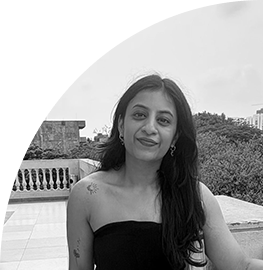
“People have kept their Diwali lights on for much longer than usual this year. When are they planning to take them down? Next year?” my roommate said while we were taking a walk in our society. “I hope they don’t take them down. Not now, not next year,” I replied. She didn’t ask me why, and I’m glad she didn’t, because it’s hard to admit that the flickering Diwali lights on the balconies, visible from my bedroom window long after the outside world has gone to sleep, act as O. Henry’s Last Leaf.
At 6 out of 24 years of age, I’ve experienced as much loneliness as opportunity in this city. I’ve discovered a new favorite word, “sonder,” its derivative tattoo, and a persistent conflict between gratitude for the space it has allowed me to grow and resentment for what it has taken away. I’ll never forget the moment I first set foot in Gurgaon: eighteen, reckless, standing on Golf Course Road, about to start architecture school. “Dad, one day I’m going to design all these glass buildings you see around. I’ll own Gurgaon’s skyline and take over New York’s in no time,” I declared. Six years later, that intention and ambition feel both hilarious and naive.
I have never visited Mumbai, which is why I never understood why people who have spent even a month there struggle to adjust to Gurgaon. The one place I have visited is Delhi—aggressively, like a beggar constantly hungry for food. I never really thought much about it until someone asked me about my favorite spot in Gurgaon, and I responded, “Oh, Sunder Nursery early morning, Chandni Chowk in the evenings, and Nizamuddin Dargah for late-night solace.” Not one of those places is in Gurgaon.
I welcome you to “my city”—Gurgaon. It’s a young adult’s dream with a promise of 24/7 alcohol and buildings tall enough to sustain its demand. If it’s still not evident, this piece, in all its rawness, addresses urban loneliness—a phenomenon that I now understand is a direct result of a transactional design ideology devoid of human-centeredness. Coming from a small town, I initially attributed this “plague” to Gurgaon’s scale. But then I realized that Delhi and Mumbai, as its older counterparts, are equally substantial in scale and relevance. Why, then, do they foster a sense of belonging, while Gurgaon, without making any extra conscious efforts, keeps you at arm’s length?
It’s the overwhelming privatization—gated societies, the unsolicited imposition of predefined social classes, and an absolute lack of spaces that add life. There’s nowhere to linger, nowhere to gossip, nowhere to sit with your thoughts, nowhere to share a cutting chai, and absolutely nowhere to get a good, piping hot plate of chole bhature. Yes, that’s it—in all its essence, Gurgaon feels like the second bhatura in a plate of chole bhature: one that is always too underwhelming, too thick, and too suffocating afterward.
Delhi has neighborhoods with character and texture—from the stinking open drains to the vibrant gastronomy coexisting with everyday street life; it’s an extremely flawed but highly livable model of a city. Mumbai is built around forced proximity and constant tension, leading to a connection that feels indispensable. These models stem from a proud identity as a “Dilliwala” or a “Mumbaikar,” which is sorely lacking in transient Gurgaon, where maximizing saleable space often comes at the cost of actual livability. Gurgaon was designed to be a top-tier, modern city but was deprived of humanity—which was left to be figured out later, and that “later” seems to have finally arrived.
The need for humanity is as essential to a space as the complete disregard for it is for profit. This is why Gurgaon is rebelling against its own design. The city may not have been planned to make its inhabitants feel lonely, but it was clearly designed without caring if that happened. The utter lack of history, tradition, culture, context, or story speaks volumes.
Community is being manufactured by paid social platforms such as Misfits and SWAG, ironically using digital tools to establish physical relationships in economically heavy “third spaces”—the kind that once thrived in age-old ‘aangan’ and under the neem tree ‘sabhas’. No amount of glamorized café culture and golf courses can satisfy the basic human need to belong—to fit in, to feel at home. The lines between work and play are being intentionally blurred with more office-cum-commercial spaces like One Horizon Centre, Cyberhub, M3M Urbana, and 32nd Avenue emerging, trying to make up for a design that failed to embed a soul within glass and concrete.
I am too much of a novice to know if there is any hope left for the city that transformed my personal ethos as a designer. All I know is that after six years here, I still don’t know if I belong or if I have just become accustomed to not belonging.